Reviewer evidence · August 2026
Reviewers are asking journals to check references first.
Non-existent citations are turning an author-side failure into an unpaid reviewer-side burden. A growing number of academics are saying plainly that existence checks belong before peer review.
Read the accounts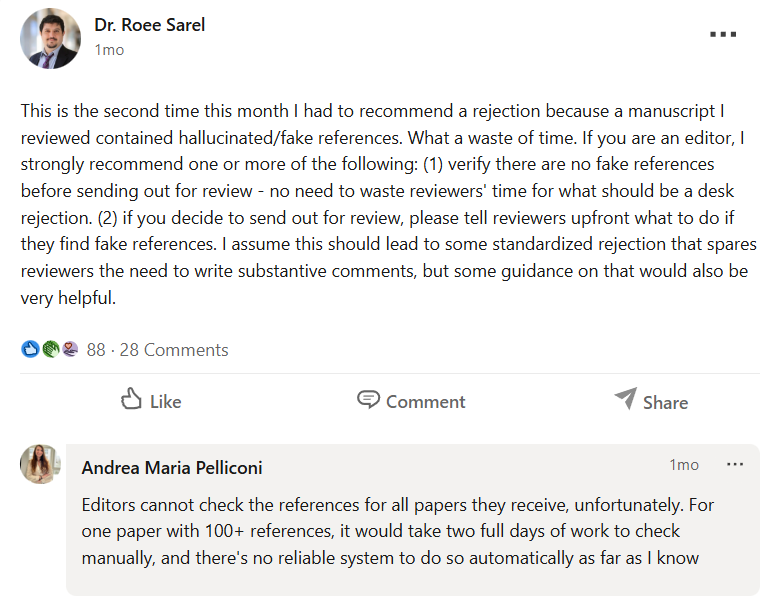
A small sample of a wider conversation
The same operational failure, seen from five angles.
The posts below represent a tiny sample of illustrative public posts from disgruntled reviewers on this topic.
Reviewers volunteer their time to evaluate content, originality, argument, contribution and so on. Establishing whether the works in a reference list exist is is evidence-based quality control that can and should happen before increasingly scarce expert time is committed.
Authors remain responsible for every citation. Pre-screening does not transfer that responsibility to journals; it gives journals a proportionate way to catch obvious problems before they become a reviewer’s problem—or a published one. There may be legitimate reasons why a reference is not findable online; authors can be asked to provide additional context in such scenarios before a paper is sent to peer review.
In reviewers’ own words
Click any screenshot to enlarge it. Each image links back to the original public LinkedIn post.
Account 01 · Legal scholarship
The desk-rejection point
After encountering fabricated references for the second time in a month, private-law academic Dr Roee Sarel puts the request directly to editors: verify first, rather than spending reviewer time on a manuscript that should not have passed triage.
Editorial implication: reference existence can be screened separately from substantive merit.
View the original postAccount 02 · Time already lost
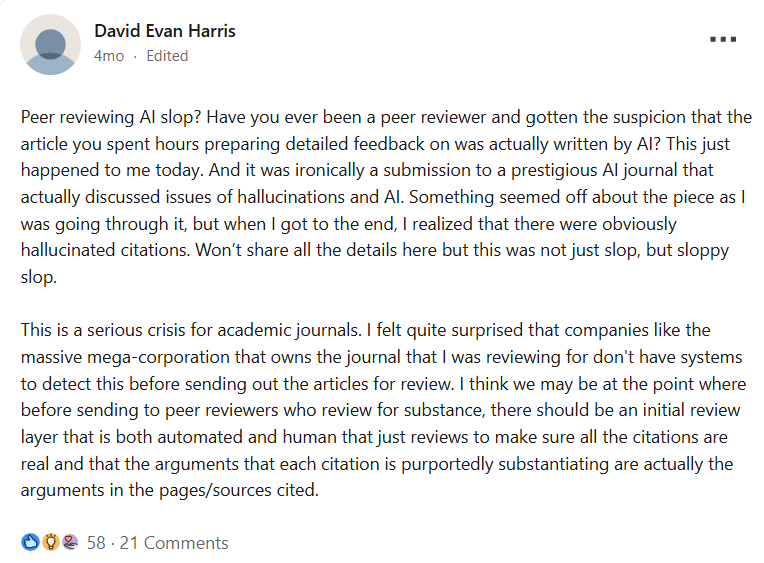
Discovery comes too late
David Evan Harris describes spending hours preparing detailed feedback before realising that citations didn't exist. His proposed remedy is an initial validation layer before substantive review begins.
Editorial implication: the cost is expert time already consumed, for scholars who are already over-burdened.
View the original postAccount 03 · A full-list check
Thirty-two references that could not be found
Sean Monkman reports checking all 40 references in one submission: four were accurate, four were traceable despite errors, and 32 appeared not to exist. He notes that some journals already (manually) check references before external review.
Editorial implication: this is solvable at workflow level; individual reviewers should not have to improvise the safeguard.
View the original postAccount 04 · Reviewer withdrawal
Goodwill has a limit
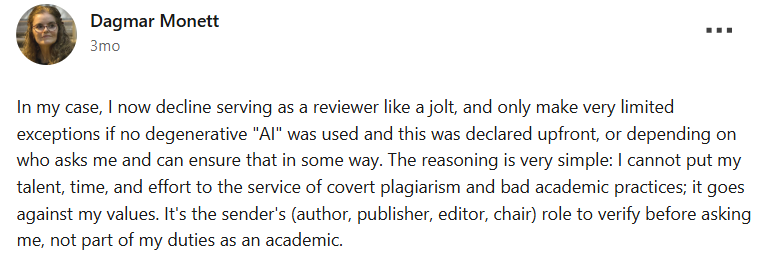
Dagmar Monett says she now generally declines to review and regards verification as the responsibility of the author, publisher, editor or chair before a manuscript reaches her.
Editorial implication: inadequate screening can affect willingness to accept the next invitation, beyond one particular paper.
View the original discussionAccount 05 · The uncertainty tax
Even genuine references now take longer
Andrew Kingdon describes checking each reference in a literature review because recent hallucinations have made verification necessary. The burden exists even when a conscientious author’s references ultimately prove sound as in this case.
Editorial implication: mistrust alone can add hours to peer review; a clear pre-screening report can restore a useful presumption of reliability.
View the original postThese five posts are a deliberately small illustrative selection from a much larger public discussion.
What reviewers are asking for
Shift the validation checks upstream.
01Before external review - catch clearly defective submissions before assigning expert labour.
02Consistently - apply the same first-pass safeguard across submissions instead of leaving each reviewer to decide what to check.
03With human oversight - provide evidence for editors rather than pretending that an automated search can settle every ambiguous source.
A practical journal response
Thorough screening without a new manual burden.
IntegriCite creates journal-specific reference-validation workflows that editors can run before a manuscript proceeds to review.
The service extracts references, including the unusually difficult citations embedded in legal footnotes, and searches for corroborating records across scholarly databases, legal case sources, official materials and the wider web.
Editors receive an inspectable report with supporting links. Strong matches are distinguished from references needing attention (which may be perfectly fine e.g. typos); absence of online evidence is treated cautiously, never as "proof" that a work does not exist.
Proportionate by design
Robust safeguarding assistance
IntegriCite doesn't make any judgement.
It makes one increasingly urgent part of initial quality control far easier, namely establishing whether submitted references can be traced to credible evidence before asking reviewers to invest their expertise.

About the creator
Lee Mager, PhD has worked in academia for two decades, primarily in HE but including six years as Editorial Manager for a highly ranked social sciences journal along with numerous academic editing roles. He is “old school” when it comes to reference integrity, which he believes is the sine qua non for building scholarly knowledge through a verifiable, historical audit trail.
He is currently Digital Innovation Lead at LSE Law School. IntegriCite grew from the many frustrations communicated by colleagues around the issue of dealing with non-existent citations in peer review.
Bespoke reference screening for journals
Let reviewers review.
If this pressure is familiar to your editorial team, let’s discuss a screening workflow shaped around your journal, its sources and its submission process.
Discuss your journal