Reviewer time
Send experts work that is ready for substantive assessment, rather than avoidable source detective work.
 IntegriCite
Reference screening for scholarly journals
IntegriCite checks whether cited sources can be verified before a submission enters peer review, helping journals protect their editorial standards and maintain the goodwill of their reviewers.
Built for editorial teams. Designed around the complexity of legal footnotes.
Peer review should test a manuscript's argument rather than whether its references exist.
Many scholarly reviewers increasingly describe hours spent on manuscripts before non-existent references came to light . Others describe checking entire reference lists simply because polished submissions can no longer be taken at face value.
That uncertainty imposes a new time tax on peer review. IntegriCite gives editorial teams a practical first line of screening that's systematic enough for large submission volumes while being cautious enough to leave genuine ambiguity to human judgement.
Authors remain responsible for every source they cite. Journal-side screening changes nothing on that front, but it provides a proportionate safeguard before increasingly scarce reviewer time is committed.
Reference problems are cheaper and considerably less public when they are found before peer review.
Send experts work that is ready for substantive assessment, rather than avoidable source detective work.
Apply a consistent pre-screen across growing submission volumes without creating another manual checklist.
Reduce the chance that an unverifiable citation survives through to publication.
Legal manuscripts mix scholarship with cases, legislation, institutional materials, chapters, reports and web sources. References may be compressed, repeated or dependent on an earlier footnote - patterns that defeat tools designed around a standard end bibliography.
IntegriCite starts with the document as legal editors receive it. It extracts the footnotes, separates the sources, follows abbreviated references where possible, and checks each identifiable work against numerous official scholarly and authoritative databases alongside web search.
| Source type | Screening route |
|---|---|
| Journal articles & books | Scholarly records |
| Cases & judgments | Authoritative sources |
| Legislation | Official records |
| Reports & web materials | Publisher / web evidence |
| Ibid, short forms & cross-refs | Contextual resolution |
IntegriCite does not make publication decisions, nor does it ever claim a source doesn't exist. It turns a time-consuming manual search, one that journals should absolutely be doing rather than peer reviewers, into a clear, reviewable report for the editorial team.
An editor submits the manuscript through a journal-specific workspace. Custom workflows can be enabled per journal needs.
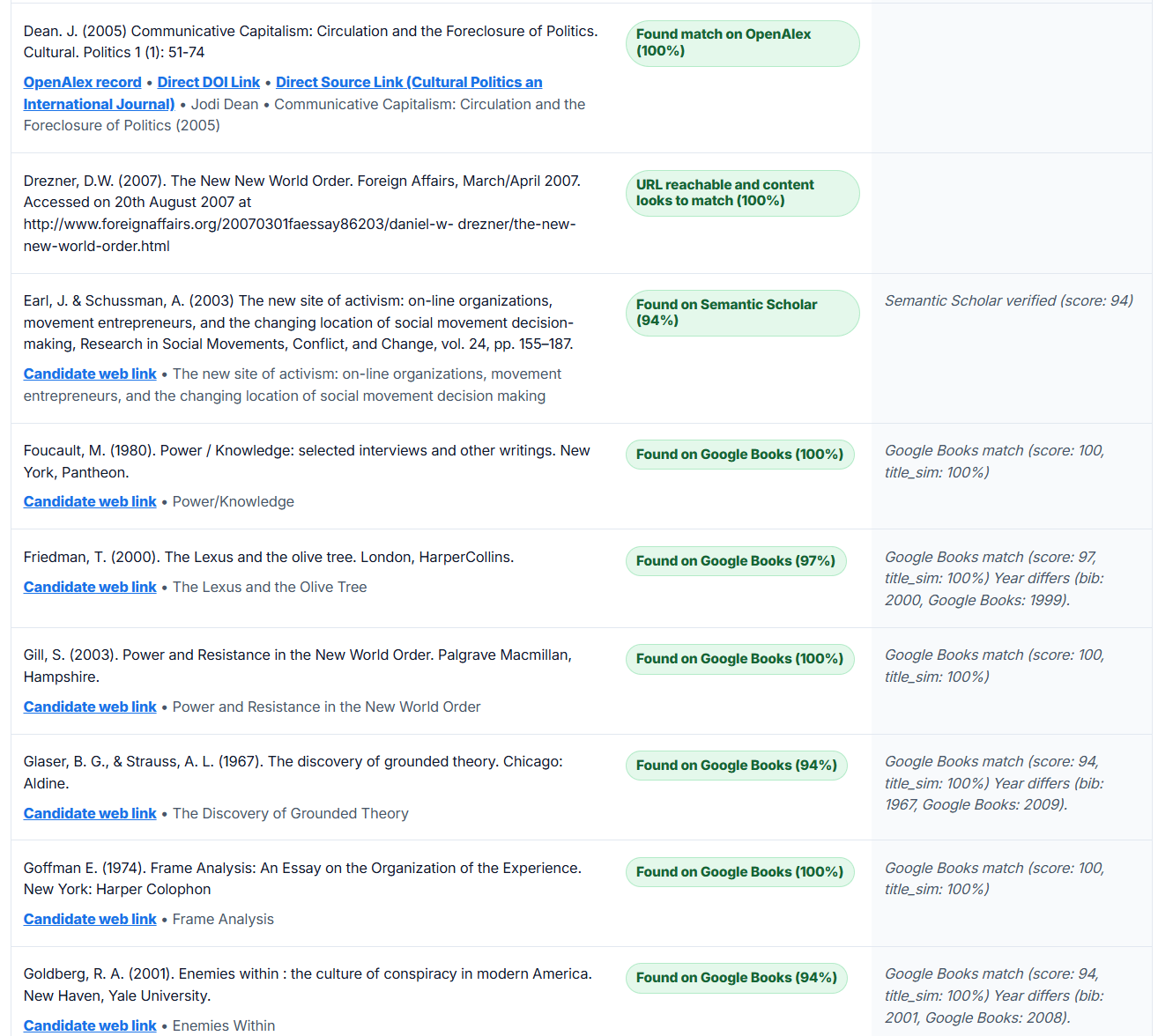
Citations are extracted and checked across scholarly databases, publishers, legal sources and the open web.
The report separates supported references from those needing attention, with evidence links for editorial judgement.
IntegriCite is designed for API-based integration with journal submission platforms, including ScholarOne Manuscripts. Integration is subject to the publisher's platform configuration and a short testing phase. Contact Lee to discuss a scoped integration pilot.
The report shows what was found, where it was found, and how closely it matches the submitted reference. Clear matches pass quickly; uncertain results remain visible for a person to assess.

Lee Mager, PhD has worked in academia for two decades, primarily in HE but including six years as Editorial Manager for a highly ranked social sciences journal along with numerous academic editing roles. He is “old school” when it comes to reference integrity, which he believes is the sine qua non for building scholarly knowledge through a verifiable, historical audit trail.
He is currently Digital Innovation Lead at LSE Law School. IntegriCite grew from the many frustrations communicated by colleagues around the issue of dealing with non-existent citations in peer review.
Reference diligence, before reputational risk
If your journal is rethinking pre-screening for an era of rising submissions, let's talk about a focused pilot.
Start a conversation