About IntegriCite · Journal reference screening
Evidence for editors./h1>
IntegriCite helps journals carry out systematic reference checks before peer review. It reports what its searches found, what remains uncertain and where an editor may wish to look next.
A rigorous first pass before expert review begins.
Reference screening is editorial decision support. It is not an automated assessment of an author’s conduct, intentions or scholarship.
IntegriCite extracts identifiable sources from a manuscript and searches for corresponding evidence across scholarly records, book catalogues, publishers, official legal materials and the wider web. The resulting report helps an editorial team identify references that appear well supported and those that merit a closer look.
That can replace a large amount of repetitive searching, but it does NOT replace editorial judgement. A cautious result is an invitation to inspect the available evidence or ask the author for clarification rather than a claim that a source doesn't exist.
The legal-journal specialism
Legal footnotes are complex.
Legal scholarship presents a particularly difficult automation problem. A single footnote may combine several sources with explanatory prose, pinpoints, cross-references and abbreviated citations that depend on earlier notes.
Those sources may include cases, legislation, treaties, official materials, books, chapters, journal articles and changing web pages. Many sit outside conventional scholarly databases, and legal articles often contain substantially more references than comparable social-science manuscripts.
IntegriCite is designed around that messy document-level context. It can also support journals using conventional reference lists, but its main value lies in handling the footnote-heavy work that creates the greatest manual burden.
- Free text
- Distinguish commentary from cited sources.
- Composite notes
- Separate multiple citations within one footnote.
- Short forms
- Resolve references that depend on earlier notes.
- Legal authorities
- Route cases and instruments beyond scholarly indexes.
- High volume
- Apply one consistent screen across long footnote sets.
How it works
A traceable search process, customised for each journal.
Each participating journal can have its own secure workspace, usage allowance and agreed custom workflow. API-based integration can be discussed where a journal or publisher wants screening inside an existing submission system.
- 1
Extract
Identify and reconstruct distinct references from the submitted manuscript, including legal footnotes and short forms where possible.
- 2
Search
Use source-appropriate routes across scholarly databases, bibliographic catalogues, legal and institutional sources, publisher pages and general web search.
- 3
Compare
Compare names, titles, dates, containers, identifiers and other available metadata rather than relying on a single keyword hit.
- 4
Report
Present the strongest available evidence and retain uncertainty for the editorial team to resolve.
The governing principle
“Not found” is a search outcome. It is not a finding that a reference does not exist.
IntegriCite deliberately avoids labels such as “fabricated reference” or “hallucinated citation.” Those are conclusions about provenance or conduct that cannot properly be drawn from an automated metadata search.
Understanding the report
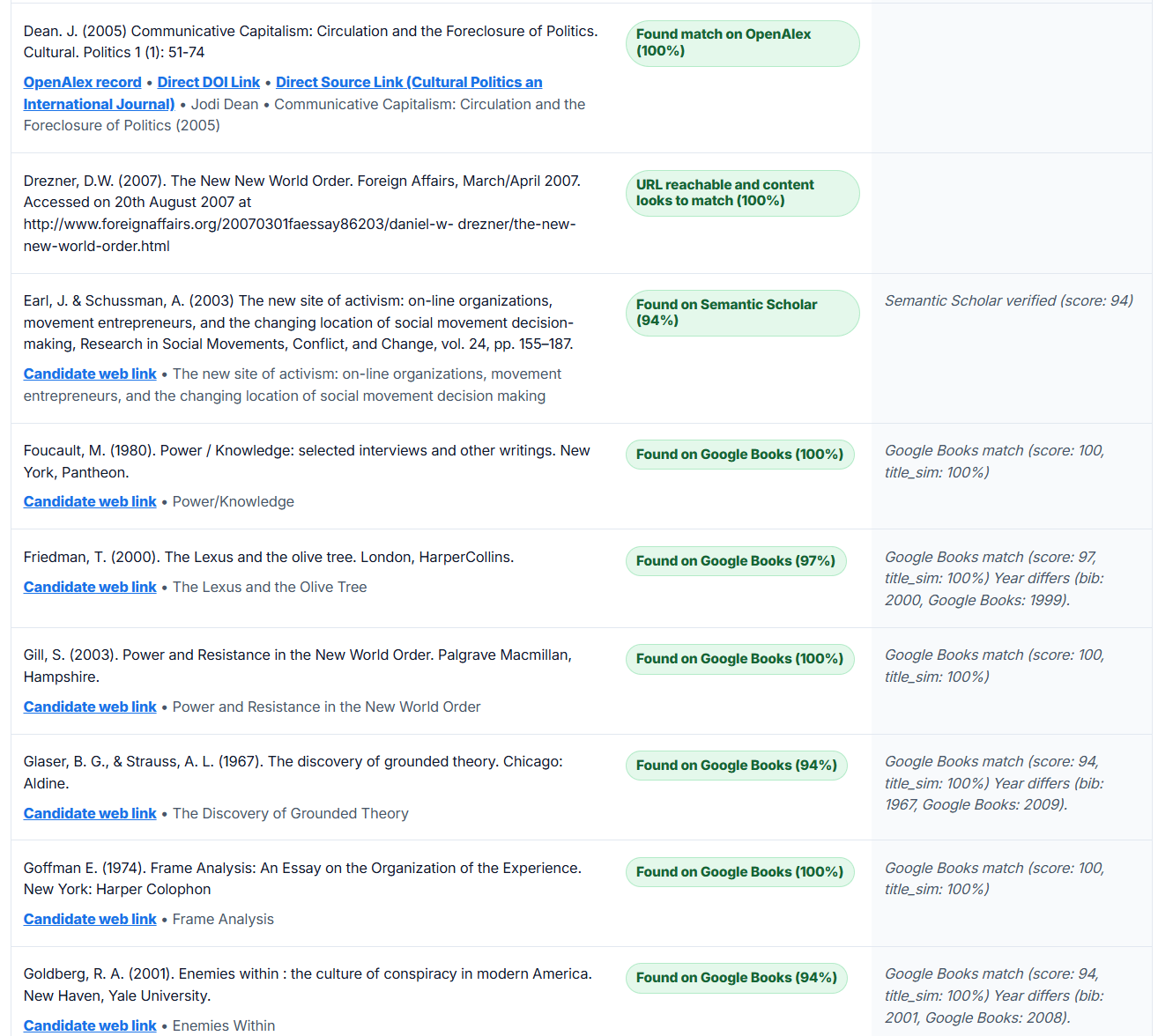
Read each result as evidence with a confidence level.
The report is designed to make editorial follow-up faster. Its statuses describe the strength and directness of the evidence located - not the quality of the manuscript or behaviour of its author.
Found
A corresponding source or record was located with sufficiently aligned metadata even if there are minor inconsistencies.
Review
Useful evidence was found, but something remains incomplete, indirect or inconsistent that is worth follow-up review.
No credible match found
The available searches did not return evidence strong enough to support the citation.
Which sources does IntegriCite search?
IntegriCite goes well beyond simple AI-enhanced web and database searching. Depending on the type of reference, it searches structured scholarly and bibliographic sources including OpenAlex, Crossref, Semantic Scholar, Google Books, Google Scholar and arXiv. For legal material, it checks public records from CourtListener and The National Archives’ Find Case Law service, alongside official and publicly searchable sources such as legislation.gov.uk, BAILII, EUR-Lex, CURIA and HUDOC. Publicly available records from other legal databases can also provide supporting evidence (proprietary services like Westlaw are not accessible publicly).
Because online metadata is often incomplete, inconsistent or simply wrong, difficult references may be checked using several differently framed web searches across publishers, institutions, courts and legal databases. IntegriCite compares titles, authors, dates, publication venues, identifiers and legal citations rather than treating a single promising keyword result as proof.
IntegriCite also checks its own purpose-built verification cache database. Eligible high-confidence verified citations can be cached for safe reuse, making repeated references faster to resolve and improving efficiency over time. As of September 2026 this database cache includes more than 4.5 million widely cited journal and book records and more than 180,000 cited law-journal citation metadata records, from open public bibliographic metadata records including CrossRef, OpenAlex and Semantic Scholar.
Why is this result showing as “review” when it clearly looks like it found the exact reference?
Often because the accessible evidence is incomplete. A publisher may expose only a search-result snippet containing the title but not the author or year. A scholarly record may match most fields while differing on date, edition, contributor or container. For a chapter or separately authored opinion, the search may have found only the parent book or judgment.
IntegriCite is intentionally reluctant to turn partial evidence into a confident result. An editor can usually resolve an obvious match quickly by opening the evidence link; the cautious labelling prevents the system from treating a plausible near-match as proof.
Does “not found” mean that the reference does not exist?
No. It means that the searches available to IntegriCite did not locate a sufficiently strong match. Older and less widely indexed materials may have little online presence. Pages move, titles change, URLs disappear, metadata can be incomplete, and some jurisdictions or publishers are poorly represented in searchable databases.
The citation itself may also contain a typo or omit the detail needed to distinguish it from similar works. The appropriate next step is editorial follow-up - often asking the author to provide a copy, stable link, identifier or corrected reference.
Does any result constitute evidence of fabrication, AI use or misconduct?
No. IntegriCite does not determine whether a reference was fabricated, whether generative AI was used, whether an author consulted a source, or whether misconduct occurred. It supplies search and matching information to support a journal’s own proportionate process.
Even a cluster of unresolved references requires human investigation and a fair opportunity for the author to clarify the citations. The report should never be presented as a misconduct finding.
What does a "found" result actually establish?
It establishes that the system located a source or bibliographic record whose available metadata aligns strongly with the submitted citation. It does not establish that the source supports the proposition for which it was cited, that every pinpoint is correct, or that the author read the work.
What is secondary-citation or existence evidence?
Sometimes the strongest result is another reliable page, article or reference list that cites the work, rather than the work or its primary catalogue record. That is useful evidence that the source likely exists, but it is indirect. IntegriCite keeps this status visible as a lead for editorial review.
What is a bibliographic record or an official mention?
A bibliographic record is a catalogue or index entry describing a work without necessarily providing its full text. An official mention is an authoritative institutional, governmental or legal source that refers to the cited material but may not be the material itself. Both can provide valuable support for existence while remaining less direct than the source or publisher record.
Why does the report suggest a possible citation error?
The searches may have located a highly similar work with one important difference - for example a nearby year, a different volume or page, a changed title, or a legal authority with matching parties but a different citation. The suggestion is a lead, not an automatic correction. The editor or author should compare the candidate with the intended source.
Why might a valid reference have no direct online match?
- It predates widespread digitisation or is held only in specialist collections.
- The publisher, database or court site blocks automated access or exposes limited metadata.
- A web page has moved, disappeared or changed its title and URL.
- The work is indexed under a translated, abbreviated or alternative title.
- The citation refers to a particular edition, chapter, opinion or version while search results describe only the parent work.
- The submitted reference contains incomplete or inaccurate metadata.
Coverage and limitations
Searchable evidence is not the same as full-text access.
IntegriCite does not have subscription access to the full holdings of commercial publishers so it can't inspect actual academic content. Everything about IntegriCite is based on metadata public facts.
For that reason, many difficult checks have to rely on bibliographic metadata and web-search snippets. Snippets can be extremely useful, but they may omit an author, date, subtitle or publication venue needed for a conclusive match. The report exposes that limitation by retaining a review status.
Coverage also varies by discipline, language, source type, age and jurisdiction. Combining several search routes improves coverage but it can't make the searchable record complete.
For journals and publishers
Practical questions
How should an editorial team use the report?
Use it as structured triage. Strong matches can usually be cleared quickly. Review results should be checked against the linked evidence. Unresolved references can be returned to the author for a stable source, copy or corrected citation before scarce reviewer time is committed.
Each journal remains responsible for deciding its own thresholds, communications and escalation process.
Is IntegriCite only for law journals?
No. Conventional bibliographies can also be screened. Legal journals are the principal specialism because footnote extraction, legal authorities, short forms and unusually high reference volumes make the work substantially harder than checking a standard reference list, so this is where the demand and value are highest.
Can the screening workflow be adapted to our journal?
Yes. A service can be shaped around the journal’s citation conventions, source mix, submission volume, editorial thresholds and preferred output. The current web workspace supports human-operated UIs including queuing multiple file uploads at once (10 max); API integration can be discussed for publishers or journals that want screening embedded in an existing submission workflow.
Why not simply ask a general-purpose AI agent like Codex or Claude Code to check the references?
These agentic AI harnesses are incredibly capable, but there are two major blockers; firstly the consumer plans are not private (Integricite never sends substantive content to any AI model, it programmatically extracts footnotes and then only individual footnotes are seen by an AI model one at a time). Secondly, if you used them for commercial purposes the token-based pricing is prohibitively expensive. Testing on a sample of real legal footnotes, Codex was between 40-50x more expensive than the distributed method Integricite has developed, which is simply not financially viable for journals at scale.
Does IntegriCite send a manuscript to an AI provider?
No. From the very beginning this service was designed with journals in mind who - rightly - have rules about not sharing academic content with 3rd party AI providers. The service uses standard text processing methods to extract footnotes and AI only ever looks at one footnote at a time (and subsequently one reference at a time when searching) with no context of the rest of the paper. Moreover Integricite does not store documents beyond the initial upload processing stage; they are not needed since citations are the only thing that matter, and storing documents is needlessly expensive anyway. The only thing IntegriCite cares about are the metadata citations themselves.
How is manuscript information handled?
The service is designed around reference metadata and limited operational storage rather than building an archive of submitted manuscripts. The precise current handling, temporary processing and retained operational records are described in the privacy notice. A journal-specific agreement can address any additional governance requirements.
How can we discuss a pilot or integration?
Email lee@automager.co.uk with a little about your journal, citation style, approximate submission volume and current screening process. An initial conversation can focus on where reference screening would fit and what a proportionate pilot should test.
Can IntegriCite integrate with ScholarOne Manuscripts?
Yes. ScholarOne provides the notification, document-retrieval and research-integrity reporting interfaces needed for this kind of automated workflow. A live integration would still require enablement and testing with the publisher's particular ScholarOne configuration.
Contact Lee to discuss a scoped integration pilot and the technical stakeholders who would need to be involved.

About the creator
Lee Mager, PhD has worked in academia for two decades, primarily in HE but including six years as Editorial Manager for a highly ranked social sciences journal along with numerous academic editing roles. He is “old school” when it comes to reference integrity, which he believes is the sine qua non for building scholarly knowledge through a verifiable, historical audit trail.
He is currently Digital Innovation Lead at LSE Law School. IntegriCite grew from the many frustrations communicated by colleagues around the issue of dealing with non-existent citations in peer review.
A cautious service for rigorous journals
Make the first check systematic.
Whether your journal uses dense legal footnotes or a conventional bibliography, get in touch to discuss a screening process that supports your editorial judgement.
Discuss your journal